Showing posts with label tires. Show all posts
Tuesday, March 19, 2019
MotorPressor pump review
Anyone who's had to seat a tire bead by inflating it with a hand-held bicycle pump is sure to know how quickly you get all pumped out. Even just airing up or down to handle different riding terrain or elevation becomes a hassle, and probably something you quickly give up on doing--especially on a hot or rainy day when you're already dripping in your riding gear.
Enter the motorized pump. There are many options available, although most them seem to be aimed at automotive use and aren't compact or rugged enough for the typical abuse of adventure riding. On a motorbike, luggage space is coveted and failure to properly inflate a tire could spell the end of your planned adventure and the start of an unplanned adventure. So, a motorized pump isn't just a luxury, it can become a necessity to ensure timely and safe repairs.
Rocky Creek Designs makes the MotorPressor, one of the few "naked" styles of mini air compressors that strips down the mechanicals to bare necessities. At CAD$69.00, it's a bargain compared to the Best Rest CyclePump I also considered, which--although offering impressive quality--also sells at a BMW-level premium for us poor Canadians. (Besides, gotta leave some room for unplanned adventure!)
The MotoPressor kit includes a decent neoprene-like pouch, some el-cheapo connector cables, and a barely-credible plastic nozzle kit. Since I already have an SAE plug connected right to the battery on my bike, the pump is ready to go as-is.
The pump itself is an all-metal beast, weighing in at around 609 grams or about a pound and a half with the case (no accessories). This is more than twice the weight of my Slime-brand pump shown beside it, which feels downright flimsy by comparison.
Besides eliminating unnecessary bulk and weight, the strategy of exposing the compressor mechanicals to open air increases the self-cooling ability of the compressor, which in theory should allow higher pumping rates for a given size. These little compressors get surprisingly hot when doing their job. Some of the enclosed designs have been reported to melt their plastic case under hard use, or are so restrained in their pumping ability to prevent overheating, that they take several long minutes to inflate a tire.
The wiring and hose on the MotorPressor seems well made, with plenty of length to be convenient without being excessive. The pump itself is a sturdy casting, although I'm not sure how the exposed gearing will resist grit, etc. -- especially when inflating in the muddy, rainy, or dusty conditions. At least it's easy to inspect and clean. A quick test shows some decent airflow and modest heat. There's no air pressure gauge, but then the one on the Slime is all but useless and I prefer a separate pressure gauge that's more accurate anyway.
Until I've had a chance to inflate a tire or seat a bead, I'll reserve final judgement on this product. But based on construction alone, I feel much more confident that it'll get me all pumped up when I really need it to.
Tuesday, January 1, 2019
Review: Shinko 700 dual-sport tires
When not running full knobbies on my WR250R (preferred combo the Dunlop D606 120/90-18 on rear, and Pirelli MT21 90/90-21 on front), I've tried the Mitas E-07 front/rear and Heidenau K60 Scout front/rear. Both the Mitas and Heidenau have great attributes are are justifiably well-rated, but they ultimately proved to be a poor match for my lightweight bike. The stiff sidewalls of the E-07 made the tires the hardest I've ever installed, and gave a stiff, uncompliant ride. In fact, one day I took off for a ride with a flat front tire and didn't really notice until I'd gone a few blocks--it was so stiff, it rolled like a regular tire slightly under-pressured, and I had to use a gauge to see if it was indeed flat. As for the Scouts, I found the rubber to be long-lasting but way too hard, especially in cooler conditions and in the wet. For both brands, I found the designs offered moderately improved traction on gravel roads versus a street-oriented dual-sport tire, but not enough to justify the choice. In particular, both the E-07 and Scout tended to wash out easily in the front, making gravel riding a little nerve-racking.
The Shinko 700 tire has been on my radar for a while, having received good reviews for traction, wear, and price. I ordered the 90/90-21 front and 4.60-18 rear. Here they are mounted on my bike beside an MT-21 (front) and D606 (rear) mounted on separate wheels for comparison.
The Shinko 700 tread looks to be more street-oriented than the E-07 or Scout, which is why I had originally hesitated to try the 700s over more aggressive designs. However, I can attest that the tread indeed performs very well on gravel (both front and rear) and achieves predictable grip with lean and changing surface conditions. In mud they perform poorly compared to a full knobby--no surprise there--but it's not as bad as I'd anticipated.
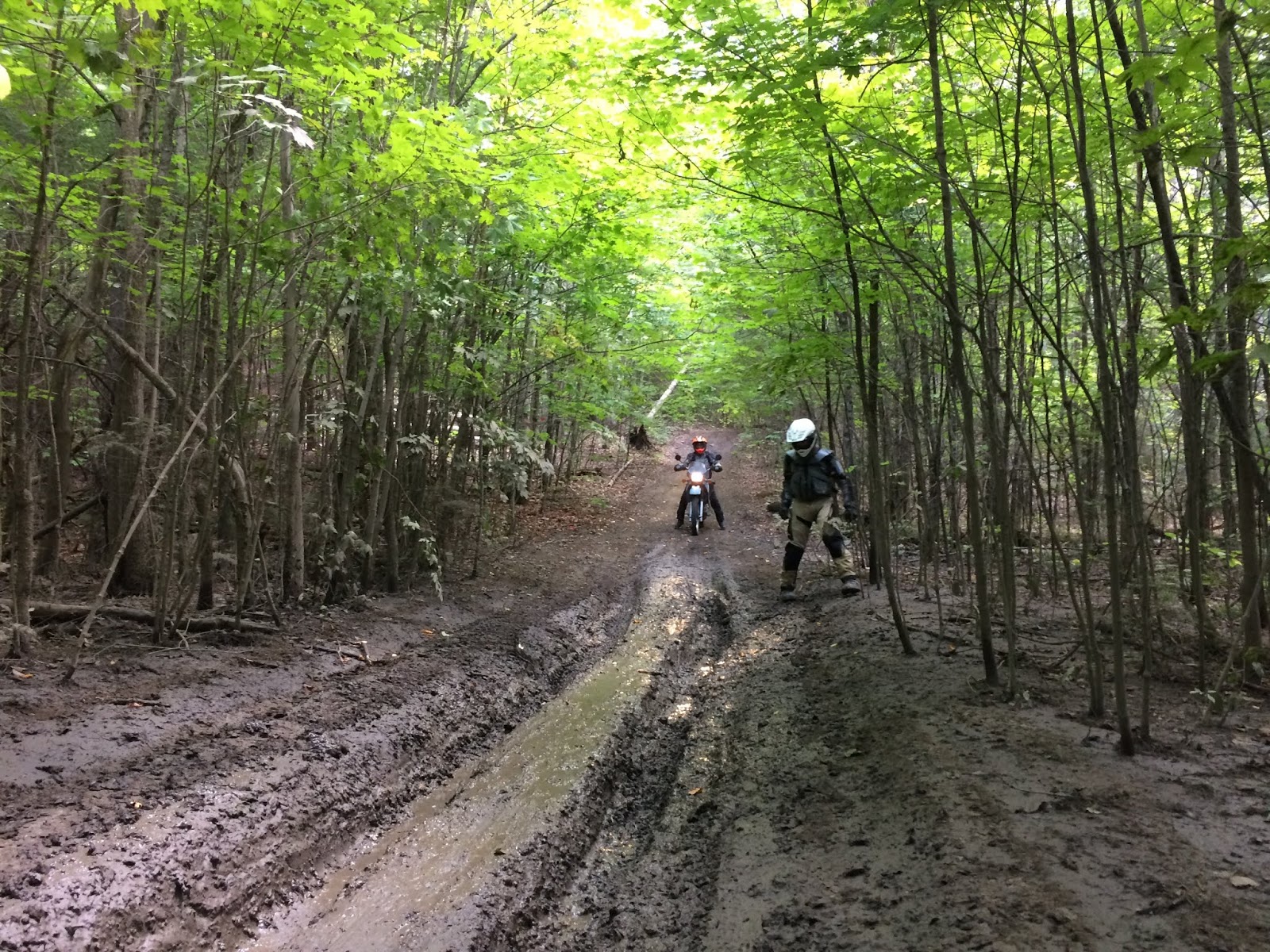
Straight-line traction in mud is decent; the real short-coming is side-traction along ruts, which is completely expected given the lack of side lugs and the high, rounded profile. As long as you hit the mud straight, keep your momentum, and spin to fling out the mud, the 700s will get you through. (Not the case for this poor KLR on a slightly less aggressive tire.)
Street performance of the Shinko is excellent, with minimal noise and vibration, and excellent cornering and acceleration. I never felt like these tires were squirmy or about to lose traction, even on wet pavement.
The flexible sidewall of these tires is key to them achieving high compliance on a light bike, and therefore improved traction and control. Although I ordered the rear in 4.60-18 (which actually measures to 4.6" or 116mm wide when mounted), it's also available in 130/80-18, which in theory is about 5.1" wide. I wasn't sure the larger tire would fit, but having run the 4.60 I can see there's plenty of room on my bike, and would recommend choosing the wider size. It should also improve floatation and grip in softer conditions, especially if you're carrying luggage and are concerned about dinging your rims.
To test these tires I rode a few hundred kilometers through some rough dual-sport terrain which included gravel, water crossings, rocks, mud, grass, and pavement. Conditions were similar to what we rode in the Rockies this past summer, on full knobbies. My sense is that if conditions are generally not muddy, the Shinko 700 would offer 90% of the performance of full knobbies while making the inevitable long paved stretches more tolerable. Overall, they seem to be an excellent tire for a great price, and I'm looking forward to seeing how they hold up over the longer term.
Wednesday, October 25, 2017
Mitas E07 tire report at 6,000km
As a near-record wet season comes to a close, I've been squeezing in a few last rides and reflecting on what kind of bike and set-up works best for me. Since the most obvious wear item on my WR250R has been tires, I've been experimenting with different options aimed at completing a month-long adventure ride.
Last May I installed a set of Mitas E07 50/50 tires on a new set of wheels I built up myself. Having run knobbies (MT21 front, D606 rear) for much of last year, my plan this year was to let the pendulum swing back the other way and see how well a more road-oriented set-up would perform on a long, dirt-oriented route (see my Round Algonquin Park report for 2017). Call it a test ride in preparation for a more ambitious attempt at riding the Trans-American Trail in 2018.
Anyone who's played with different tires knows there's no one perfect choice for all-round adventure riding. Bike type, riding style, load, route distance, and of course route conditions all factor in to selecting appropriate rubber. On my WRR I've previously run the original Trailwings (horrible on pavement and dirt); Scorpion Pro FIM front and K760 rear (K760 wears fast and can break loose unpredictably in the dirt, and the Scorpion can wander in gravel); Heidenau K60 Scouts (overall decent on pavement and gravel, but useless in mud); the classic combo of MT21 front with D606 rear (the best handling and wearing knobbies I've tried). Sure, knobbies are great in loose gravel and dirt, but they vibrate and wear out fast in the rear--especially on hot pavement and with a loaded bike. They're a poor choice for longer rides involving slab unless you can change your rear tire every 3,000-5,000 km. So, what to choose?
Having had a generally good experience with the K60 Scouts, I thought that perhaps a "better" version of the 50/50 concept could offer extended wear life and a slight improvement in dirt handling, opening the door to longer adventure rides on rough terrain where a small bike shines. Various forums raved about Mitas tires, and particularly the E07 which is rated as a 50/50 tire with exceptional wear due to Kevlar fibers incorporated into the rubber. Having now ridden almost 6,000km on these tires (much less than planned, thanks to all the rain and mud this season), it's clear they've held up well in terms of general wear:
The front appears hardly scuffed, and although the rear has squared off a bit, there's still a good 5mm or so of tread above the central rib and lots of tread depth below that.
Now with more kilometers on these under my belt, my overall impression has shifted since my first review. They still handle well in gravel, but as my speed and skills have naturally improved over the season I think I quickly reached the grip limit of the front tire and got a little frustrated with my front wheel drifting and washing out in the loose stuff. At the same time, as the already low tread in the rear wore away, I found traction in the wet stuff noticeably diminished. Altogether, it quickly became tedious navigating any kind of mud, where holding a line was almost impossible with the low lateral traction. This can be forgiven in the rear (as long as you can maintain momentum), but having the front constantly slide around because a serious liability.
Interestingly, the tires performed much better overall when my bike was fully loaded with bags and gear. Indeed, the combo worked surprisingly well in loose sand with a loaded bike, although it was sometimes a struggle to keep a line. Perhaps the lack of knobbies prevented the front from ploughing in and dumping the bike, which is a risk if you can't keep your weight back and throttle up. The enhanced performance with a loaded bike is likely because the E07s are tremendously stiff--especially the front, which is the even stiffer "Dakar" version. The unloaded weight of my bike and rider simply isn't enough to form a decent contact patch without almost deflating the tire. In fact, after one short ride I discovered my front tire was completely out of air and yet it was almost unnoticeable when riding! On the other hand, the stiff sidewalls offered great pinch protection in the rough stuff, although somehow I still managed to put a minor ding in my front rim.
My conclusions on running these tires on a small bike are as follows:
Anyone who's played with different tires knows there's no one perfect choice for all-round adventure riding. Bike type, riding style, load, route distance, and of course route conditions all factor in to selecting appropriate rubber. On my WRR I've previously run the original Trailwings (horrible on pavement and dirt); Scorpion Pro FIM front and K760 rear (K760 wears fast and can break loose unpredictably in the dirt, and the Scorpion can wander in gravel); Heidenau K60 Scouts (overall decent on pavement and gravel, but useless in mud); the classic combo of MT21 front with D606 rear (the best handling and wearing knobbies I've tried). Sure, knobbies are great in loose gravel and dirt, but they vibrate and wear out fast in the rear--especially on hot pavement and with a loaded bike. They're a poor choice for longer rides involving slab unless you can change your rear tire every 3,000-5,000 km. So, what to choose?
Having had a generally good experience with the K60 Scouts, I thought that perhaps a "better" version of the 50/50 concept could offer extended wear life and a slight improvement in dirt handling, opening the door to longer adventure rides on rough terrain where a small bike shines. Various forums raved about Mitas tires, and particularly the E07 which is rated as a 50/50 tire with exceptional wear due to Kevlar fibers incorporated into the rubber. Having now ridden almost 6,000km on these tires (much less than planned, thanks to all the rain and mud this season), it's clear they've held up well in terms of general wear:
The front appears hardly scuffed, and although the rear has squared off a bit, there's still a good 5mm or so of tread above the central rib and lots of tread depth below that.
Now with more kilometers on these under my belt, my overall impression has shifted since my first review. They still handle well in gravel, but as my speed and skills have naturally improved over the season I think I quickly reached the grip limit of the front tire and got a little frustrated with my front wheel drifting and washing out in the loose stuff. At the same time, as the already low tread in the rear wore away, I found traction in the wet stuff noticeably diminished. Altogether, it quickly became tedious navigating any kind of mud, where holding a line was almost impossible with the low lateral traction. This can be forgiven in the rear (as long as you can maintain momentum), but having the front constantly slide around because a serious liability.
Interestingly, the tires performed much better overall when my bike was fully loaded with bags and gear. Indeed, the combo worked surprisingly well in loose sand with a loaded bike, although it was sometimes a struggle to keep a line. Perhaps the lack of knobbies prevented the front from ploughing in and dumping the bike, which is a risk if you can't keep your weight back and throttle up. The enhanced performance with a loaded bike is likely because the E07s are tremendously stiff--especially the front, which is the even stiffer "Dakar" version. The unloaded weight of my bike and rider simply isn't enough to form a decent contact patch without almost deflating the tire. In fact, after one short ride I discovered my front tire was completely out of air and yet it was almost unnoticeable when riding! On the other hand, the stiff sidewalls offered great pinch protection in the rough stuff, although somehow I still managed to put a minor ding in my front rim.
My conclusions on running these tires on a small bike are as follows:
- The E07 front (especially the stiff Dakar) isn't worth it unless your bike is fully loaded. It would be a strong contender for a heavier bike like the Africa Twin, where you're probably not as likely to ride much rough single track and so the lower traction in those conditions isn't as much of an issue.
- The E07 rear is so heavy and hard to change (easily the hardest tire I've tried!) that it too is not one I'd recommend for lighter bikes. A K60 Scout would probably offers reasonably comparable performance and wear, at significantly lower weight and cost, and would be much easier for a tired rider to change trail-side.
- Having switched my front tire back to an MT21, I have to say it makes a great combo with the 50/50 rear: all the front traction you need to corner and maintain a secure line (loaded or unloaded), with the smooth-rolling wear and acceptable traction of a 50/50 rear.
Sunday, May 7, 2017
Mitas E-07 on WR250R: ride review
Almost threw away my bike today. After yesterday's struggle to mount the Mitas E-07 rear, it was rather deflating to discover that, well, my rear tire had deflated overnight. The sidewalls are so stiff that it was only noticeable the rear was flat when I checked with an air pressure gauge. It was sitting at zero. Bummer.
However, practice makes perfect, and having pre-stretched the rear tire mounting it twice already, it was a lot faster removing it for a third time to inspect the inner tube. There were no obvious punctures, even when submerging in water. Huh... could it have been my imagination? Might as well remount the tire and ride. This time I made sure to inflate to a measured 21 psi so I could see how it held up.
With snow, rain, and sleet in the forecast it was the perfect Canadian summer day to venture onto saturated concession roads to give these tires a proper dual-sport workout. Terrain was a mix of asphalt, freshly-laid gravel, hard-pack wet clay, organic mud, exposed limestone and granite, loose rocks and baby heads, and the usual assortment of mud-holes and stutter bumps that are representative of the roads within a 30-minute drive of our nation's capital. Water everywhere. This is what I consider proper 50/50 ADV riding: it's bread-and-butter conditions in Eastern Ontario. Any more mud than this (especially the sticky clay stuff we have) or steeper terrain, and I'd err on the side of full knobbies.
Off we go, following last weekend's Paris-Roubaix bike race route. Beside testing the tires, I'd swapped my gearing back to the 13/47 I've run for the last two years, instead of the 13/45 which I tried yesterday but found too sluggish.
However, practice makes perfect, and having pre-stretched the rear tire mounting it twice already, it was a lot faster removing it for a third time to inspect the inner tube. There were no obvious punctures, even when submerging in water. Huh... could it have been my imagination? Might as well remount the tire and ride. This time I made sure to inflate to a measured 21 psi so I could see how it held up.
With snow, rain, and sleet in the forecast it was the perfect Canadian summer day to venture onto saturated concession roads to give these tires a proper dual-sport workout. Terrain was a mix of asphalt, freshly-laid gravel, hard-pack wet clay, organic mud, exposed limestone and granite, loose rocks and baby heads, and the usual assortment of mud-holes and stutter bumps that are representative of the roads within a 30-minute drive of our nation's capital. Water everywhere. This is what I consider proper 50/50 ADV riding: it's bread-and-butter conditions in Eastern Ontario. Any more mud than this (especially the sticky clay stuff we have) or steeper terrain, and I'd err on the side of full knobbies.
Handling on loose gravel at up to 90km/hr was excellent. Cornering was predictable with a smooth transition to slide, so it was easy to feel the limits and stay within them. Combined with the suspension tuning I had done last fall, control over the stutter bumps was excellent.
Now it's into the woods. You can see the treads aren't picking up any mud yet:
Lots of streams cutting through:
This water hole was about 4m across and 30cm deep, and covered with silty mud on the bottom. Didn't quite suck in the wheel but it wasn't a smooth roll-through. No problems with traction.
You can that tire makes a decent impression. Forward traction was surprisingly good. There was a little bit lateral slip in the greasier mud, which is to be expected given these aren't knobbies.
This is the greasier mud. As long as I took a level line and kept some momentum, there was no problem with traction. It was easy to forget I wasn't on my regular knobbies (MT-21 front and D606 rear), which I'd used to ride this same route last weekend when conditions were better (although a cyclist crashed in this very mud hole, compressing his spine and cracking some ribs, requiring a trip to hospital).
Finally, some forest road. Easy to fly on this stuff. Just have to be careful of the front wheel, which obviously doesn't have the same grip as a knobby and risks washing out if not careful.
One more slimy mud-hole. The main line is foolish; I took the side where there's a narrow, off-camber line around the swimming pool. One lateral slip and you're in the drink. The tires had no problem preventing a lateral slide.
Now for some different mud: lots of organics, lots of slime. I had to wait for a truck to pass me from the other direction. It churned things up pretty well in the deeper spots. I was able to ride through the foot-deep mush and standing water on the sides no problem.
More forest road, this time with lots of exposed rocks, sharp edges, and baby heads. Here's where the stiff sidewalls of the E-07s really shone: no harsh bang as you hit the square edges; I just rolled right through them. Great traction on the wet rocks.
On returning home after 80km of riding, the rear tire pressure had dropped to 18 psi. Rats--this means there's some kind of slow leak and it's not obvious where. It's a brand new tube, too. Will need to dismount the tire for the fourth time to inspect again. Either that or put a shot of latex sealant into the tube in the off-chance that any pin-prick is on the outer perimeter.
Conclusions
Overall these are impressive tires. Despite some initial trepidation running such a heavy and stiff tire on my small bike, for the type of riding I do these tires look like they'll perform well, especially when the bike's loaded with gear. The Dakar version of the front E-07 isn't too stiff, and in fact improves resistance to pinch flats that have concerned me when running lighter tires like the MT-21.
The rear tire also performs well, showing much improved lateral grip compared to the Heidenau K60 Scouts which is a similar design (but significantly lighter and with less aggressive tread). It's only obvious drawback so far is it's utter obstinance in mounting. This is not a tire you'd like to face when repairing a flat on some mosquito-infested backwoods trail on a hot day (although the heat could only make it easier to stretch).
Together these tires offer well-matched, predictable handling across the full speed range of the WR250R. The Kevlar threads in the rubber formulation promise above-average wear resistance. The additional weight of the tires isn't really as noticeable in straight-line acceleration with the 13/47 gearing swapped back in, although the steering isn't quite as responsive. Once the bike's loaded with gear these differences won't be as noticeable. Having now tried 13/43 (stock), 13/45, 13/47, and 13/48 gearing, I have to say 13/47 is really the best all-around combo for the WR250R: it achieves the optimal tradeoff between torque and acceleration at low speed, and top-end for the inevitable paved sections between trails. It's easy to cruise at 90km/hr without feeling buzzy.
I wouldn't recommend the Mitas E-07 for small bikes where you're not planning to carry gear. The weight penalty, stiff sidewalls, and difficulty in mounting the rear tire just aren't worth it. Not sure what I'd choose instead (other than knobbies), but it's unlikely I'd go back to a Heidenau which, for a 50/50 tire, doesn't offer nearly as much grip or durability as the E-07.
These would be my first choice of tires for any bigger ADV bike like the KLR650 or the Honda Africa Twin (a current dream bike), which takes a 90/90-21 in front (E-07 Dakar would be ideal) and 150/70-18 in the rear. A Dakar version in back may be unnecessary unless you're on the heaviest of ADV bikes (like a 1200GS), since the regular version is already so stiff.
Update September 21, 2017
After riding 2500 km of 50/50 trail and road on my RAP adventure this summer, plus another few thousand kms of road, gravel, and trail on day-trips, I'm surprised to see how much of the rear tire has worn down. A few millimeters of tread depth remains above the central recessed strip, and the sides look hardly worn. Overall the profile is noticeably squared off, probably a consequence of hard acceleration with bags on. The front tire still looks new. Dirt handling remain OK (and the stiff sidewalls of the front tire are awesome on square edges and rocks), but given the wear on the rear, I'm questioning any advantage these tires may offer besides road comfort and low noise, and may end up reverting back to an MT21/D606 combo which is cheaper.
Saturday, May 6, 2017
Dualsport tire review: Mitas E-07
Torrential rains and widespread flooding have resulted in few riding opportunities, so it's a good time to play in the shop and mount the Mitas E-07 tires that arrived recently. Here're the rear and front E-07 tires next to the MT21 on my front wheel.
I'd been looking for a 50/50 tire that offered more durability than the knobbies (MT-21 front, D606 rear) I'd left on the bike since last season, in the hopes of doing a long ADV ride somewhere this summer. The Mitas E-07 has gotten great reviews for durability, and apparently it edges out the Heidenau Scout K60 for grip and handling. However, I couldn't find many reviews of these tire on smaller DS bikes so I'm curious to see how they work on my WR250R.
The first thing I noticed when my shipment arrived was how heavy the box was. There was a set of tubes in the box as well, but really--it was kinda shocking. When you're on a small ADV bike with little horsepower to start with, it's important to watch weight--especially on wheels, where the extra rotating mass really affects suspension performance, acceleration, and handling. So I was concerned about how the E-07 would feel in action and weighed my last three tire combos for comparison.
Here's the line-up for comparison, with Scouts on the left and E-07's on the right, with my D707 in the middle.
All tires have approximately the same dimensions for carcass and tread on front/rear. Weights are approximate: the Scouts and knobbies were worn, and my fish scale was giving me trouble.
Heidenau K60 Scout
90/90-21: 3.9kg
4.00-18: 6.0 kg
Knobbies
Pirelli MT21, 90/90-21: 3.8kg
Dunlop D606, 120/90-18: 5.5kg
Mitas E-07 (50/50 dirt/road)
90/90-21 Dakar: 4.4kg
120/80-18: 7.8kg
Wow, the rear E-07s is more than 3kg (6 lbs) heavier than the D606! Must be all that depleted uranium Mitas adds to their rubber to resist wear.
Oh, these were going to be hard to mount. Just getting the inner tube into the rear tire before mounting it on the wheel was a challenge. In fact, the E-07s were the hardest tires I've ever mounted, made worse by cold temperatures. There hasn't been any hot sun to pre-heat the rubber in over a week, and leaning the tires over a baseboard heater barely helped. A couple of hours had slipped away unnoticed while I cursed and used every trick I knew to pry these solid blocks of rubber onto the wheels I'd built up last fall. Eventually the tires yielded! However, if I flat in the boonies, I would be tempted to just push my bike into a swamp and go buy a new one rather than try to change the tube. On the other hand, the rubber may be stiff enough to ride for quite a distance without any air. Hopefully I don't need to test that theory.
As part of the exercise I swapped out my 48T sprocket for a 45T (leaving the 13T up front), on the theory this would give me just enough extra top-end for the highway while not being as sluggish as the stock 13/43 gearing on trails and with baggage. This required shortening my chain by two links because the axle was already at the back of its travel.
Time for a rip around the country block over a mix of mud, gravel, and pavement, and in the pouring rain.
I immediately noticed the lack of acceleration: a combination of tire weight and the higher gearing. To my surprise, and despite having the throttle pinned, I just wasn't accelerating beyond 95km/hr (GPSed) on a straight flat section with no wind. This is one reason why Yamaha and Honda really need to offer a 400-450cc version of their small ADV bikes--the extra ponies make all the difference when carrying baggage. When I shifted into 6th it felt like a useless gear, more of an overdrive.
Otherwise, handling felt pretty good: no discernible wandering in the ruts, solid traction in the puddles and rain. However, the tires did feel harsh because of the stiff sidewalls (the Dakar version incorporates and extra sidewall ply to make it stiffer), and running about 20psi front/25psi rear. Airing down about 5 psi and warm tires will certainly help.
Nevertheless, coming from a 48T rear sprocket, the torque of the 45T sprocket just felt too low. So I swapped it for the 47T I'd run last year. Haven't re-tested it yet, but I suspect it'll be a reasonable compromise. Now that my chain is 2 links shorter, I was just able to put it together with the axle all the way forward. That left about 1cm between the rubber and the mud guard on the swingarm. It's a new chain, so after it breaks in a bit the clearance should only improve as I move the rear axle back.
The jury's out on these tires until I get a chance to ride them in more summer-like conditions (i.e. above 10C and on dry pavement and trails). If not for the wear rating I'd probably not choose these tires for my bike. At these weights they're clearly not aimed at small bikes, and I wouldn't hesitate to run them on a big ADV machine. Obviously I'm pushing the WRR (and these tires) beyond their intended usage so there's going to be some compromises. And if the weather doesn't improve this year I may need to revert to knobbies anyway, regardless of the wear implications!
I'd been looking for a 50/50 tire that offered more durability than the knobbies (MT-21 front, D606 rear) I'd left on the bike since last season, in the hopes of doing a long ADV ride somewhere this summer. The Mitas E-07 has gotten great reviews for durability, and apparently it edges out the Heidenau Scout K60 for grip and handling. However, I couldn't find many reviews of these tire on smaller DS bikes so I'm curious to see how they work on my WR250R.
The first thing I noticed when my shipment arrived was how heavy the box was. There was a set of tubes in the box as well, but really--it was kinda shocking. When you're on a small ADV bike with little horsepower to start with, it's important to watch weight--especially on wheels, where the extra rotating mass really affects suspension performance, acceleration, and handling. So I was concerned about how the E-07 would feel in action and weighed my last three tire combos for comparison.
Here's the line-up for comparison, with Scouts on the left and E-07's on the right, with my D707 in the middle.
All tires have approximately the same dimensions for carcass and tread on front/rear. Weights are approximate: the Scouts and knobbies were worn, and my fish scale was giving me trouble.
Heidenau K60 Scout
90/90-21: 3.9kg
4.00-18: 6.0 kg
Knobbies
Pirelli MT21, 90/90-21: 3.8kg
Dunlop D606, 120/90-18: 5.5kg
Mitas E-07 (50/50 dirt/road)
90/90-21 Dakar: 4.4kg
120/80-18: 7.8kg
Wow, the rear E-07s is more than 3kg (6 lbs) heavier than the D606! Must be all that depleted uranium Mitas adds to their rubber to resist wear.
Oh, these were going to be hard to mount. Just getting the inner tube into the rear tire before mounting it on the wheel was a challenge. In fact, the E-07s were the hardest tires I've ever mounted, made worse by cold temperatures. There hasn't been any hot sun to pre-heat the rubber in over a week, and leaning the tires over a baseboard heater barely helped. A couple of hours had slipped away unnoticed while I cursed and used every trick I knew to pry these solid blocks of rubber onto the wheels I'd built up last fall. Eventually the tires yielded! However, if I flat in the boonies, I would be tempted to just push my bike into a swamp and go buy a new one rather than try to change the tube. On the other hand, the rubber may be stiff enough to ride for quite a distance without any air. Hopefully I don't need to test that theory.
As part of the exercise I swapped out my 48T sprocket for a 45T (leaving the 13T up front), on the theory this would give me just enough extra top-end for the highway while not being as sluggish as the stock 13/43 gearing on trails and with baggage. This required shortening my chain by two links because the axle was already at the back of its travel.
Time for a rip around the country block over a mix of mud, gravel, and pavement, and in the pouring rain.
I immediately noticed the lack of acceleration: a combination of tire weight and the higher gearing. To my surprise, and despite having the throttle pinned, I just wasn't accelerating beyond 95km/hr (GPSed) on a straight flat section with no wind. This is one reason why Yamaha and Honda really need to offer a 400-450cc version of their small ADV bikes--the extra ponies make all the difference when carrying baggage. When I shifted into 6th it felt like a useless gear, more of an overdrive.
Otherwise, handling felt pretty good: no discernible wandering in the ruts, solid traction in the puddles and rain. However, the tires did feel harsh because of the stiff sidewalls (the Dakar version incorporates and extra sidewall ply to make it stiffer), and running about 20psi front/25psi rear. Airing down about 5 psi and warm tires will certainly help.
Nevertheless, coming from a 48T rear sprocket, the torque of the 45T sprocket just felt too low. So I swapped it for the 47T I'd run last year. Haven't re-tested it yet, but I suspect it'll be a reasonable compromise. Now that my chain is 2 links shorter, I was just able to put it together with the axle all the way forward. That left about 1cm between the rubber and the mud guard on the swingarm. It's a new chain, so after it breaks in a bit the clearance should only improve as I move the rear axle back.
The jury's out on these tires until I get a chance to ride them in more summer-like conditions (i.e. above 10C and on dry pavement and trails). If not for the wear rating I'd probably not choose these tires for my bike. At these weights they're clearly not aimed at small bikes, and I wouldn't hesitate to run them on a big ADV machine. Obviously I'm pushing the WRR (and these tires) beyond their intended usage so there's going to be some compromises. And if the weather doesn't improve this year I may need to revert to knobbies anyway, regardless of the wear implications!
Tuesday, April 25, 2017
New dual sport tires: Mitas E-07
Correction: I originally posted these as E-09... they are actually E-07. They just arrived from MX1 Canada today and I'm excited to try them out, as they've been getting rave reviews in various ADV forums as excellent all-rounders (50/50 dirt/road) with terrific durability.
Front is a 90/90-21 in the Dakar version of the tire, which in the Mitas line means it incorporates a stiffer sidewall than non-Dakar versions. The Dakar versions are recommended for bigger DS bikes. While I'm putting these on my WR250R, the regular version of the front was not available and hopefully the Dakar isn't too stiff.
Rear is a 120/80-18 in non-Dakar version.
The knobby on my front wheel is an MT-21 with about 3,000km of mostly dirt riding.
These Mitas tires incorporate Kevlar fibers to increase tread durability. Riders consistently report getting well over 10,000 km out of a set of these tires, which is insanely good mileage -- especially when you have to flog it on long sections of pavement to get to the good stuff.
Will post a more detailed review once I get these mounted up on my second set of wheels.
MX1 just received a major shipment from Mitas in early April, so selection should be good.
Front is a 90/90-21 in the Dakar version of the tire, which in the Mitas line means it incorporates a stiffer sidewall than non-Dakar versions. The Dakar versions are recommended for bigger DS bikes. While I'm putting these on my WR250R, the regular version of the front was not available and hopefully the Dakar isn't too stiff.
Rear is a 120/80-18 in non-Dakar version.
The knobby on my front wheel is an MT-21 with about 3,000km of mostly dirt riding.
These Mitas tires incorporate Kevlar fibers to increase tread durability. Riders consistently report getting well over 10,000 km out of a set of these tires, which is insanely good mileage -- especially when you have to flog it on long sections of pavement to get to the good stuff.
Will post a more detailed review once I get these mounted up on my second set of wheels.
MX1 just received a major shipment from Mitas in early April, so selection should be good.
Labels:
dualsport,
motorcycle,
review,
tires,
wheels
Subscribe to:
Posts (Atom)