Showing posts with label Tenere 700. Show all posts

Wednesday, June 30, 2021

Tenere 700 - Suspension tuning update - Vast improvements!

Riders looking to get more practical performance out of their bike (whether motorcycle or bicycle, for that matter) are wise to first invest in tires and then suspension. Suspension tuning is especially vital to getting the most from your ride. Unless you fit the manufacturer's narrow criteria for rider weight (and many Japanese bikes are under-spring from the factory), chances are your bike will not handle as well as it could--especially on rough terrain.

Accelerated Technologies just north of Peterborough, Ontario, specializes in suspension tuning for all manner of vehicles, but especially sleds, ATVs, and motorbikes. John Sharrard, the brains and owner of the operation, is a former professional racer with championship titles to his name as well as some serious chops as a factory race tech for Honda and Yamaha. He had previously worked magic on my WR250R, completely transforming its off-road and on-road handling. Thus inspired, I was eager to bring him my 2021 Tenere 700 at the end of my first season with the bike, looking for a similar transformation. 

Having read countless online discussions about tuning the Tenere, a clear consensus emerged on the limitations of the factory setup. Mainly: the rear is under-sprung for riders above 165 lbs; putting in a stiffer shock spring requires additional damping beyond what the stock valving will achieve; and there are many complaints with high-speed compression damping front and rear. In addition, many people report that the clickers (fork and shock) have a much narrower range of effectiveness than the total number of potential clicks would suggest--imposing further limits on what damping you can achieve with the stock valving. Unfortunately, you need to modify the suspension if you're heavier than 75kg/165lbs and you plan to push the bike around in the dirt as it was intended to be used. 

For reference, I'm 91kg/200lbs in my birthday suit and 104kg/230lb in my riding suit. The tuning plan was to choose springs based on just me on the bike with no luggage and no preload applied so I'd have maximum range on the preload adjustment for when carrying luggage. That meant changing the shock spring. Interestingly, his sag measurements suggested that the factory fork springs were sufficiently rated--a bit of a surprise to me, given some of the online discussions I'd seen. 

Originally, I had installed an 80N-m shock spring from Rally Raid as well as the Rally Raid preload fork caps. While the stiffer shock spring reduced bottoming, John's opinion was that it still wasn't stiff enough. In fact, he noted that my shock appears to have bottomed even without luggage, so he wondered if that was the source of the harshness I'd felt. (However, I suspect the o-ring was in its lowest position based on other work I'd done.) John also felt the Rally Raid spring was the wrong dimensions for the application, so he replaced it with a longer version rated to 98N-m. As for re-valving, we agreed on a linear strategy to stiffen up the compression damping front and rear. This can be tricky to get right with a progressive linkage in the rear, so we just had to try something and go from there. 

By the time the first re-valving was completed, it was winter (-20C and snow) and unsafe to do a proper test ride. So I had to wait until spring to finally try it. Unfortunately, as soon as I hit the bumpy spring roads, I found the new setup to be extremely harsh. Low-speed compression damping could be managed by the clickers, but high-speed compression damping was so harsh that the bike would catch air off small expansion joints. Dirt roads and stutter bumps were a nightmare to ride at all but the lowest (or unsafely highest) speeds. And hitting any minor pothole or rock was like getting a 2x4 in my backside--leading to a wipeout on one trail that was obviously caused by the wheels pinging off ruts instead of rolling through them. Forget about hitting a pothole while cornering. The bike was simply far too harsh to ride for any length of time except on the smoothest roads or while standing. The high-speed compression damping needed to be dialled way back--but at least we now had some goalposts to work from. 

Below are the shock and fork setup notes from Accelerated Technologies. The details may be a little hard to decipher, so I've tried to decipher them below.


Shock tuning

Factory shock valving (9 valve shims):

  • 34 x 0.15
  • 32 x 2.0
  • 30 x 0.20
  • 28 x 0.20
  • 26 x 0.20
  • 22 x 0.20
  • 20 x 0.25
  • 20 x 0.25
Shock revalving attempt #1 (done at end of first season; red indicates the changes from factory):
  • 24 x 0.10
  • 32 x 2.0
  • 30 x 0.20
  • 28 x 0.20
  • 26 x 0.20
  • 22 x 0.20
  • 20 x 0.20
  • 18 x 0.20
  • 16 x 0.20
  • Washer

As noted, this setup was way too harsh and unrideable. Not recommended! Back to Accelerated Technologies for round #2. This time I rode my bike there and back - 650km in a day, to allow for testing. I brought my camping gear and set up in the back lot while they worked on my bike. Happy company with Bear, the shop dog, who was probably more interested in my lunch. 

Shock revalving attempt #2 (only 8 valve shims):

  • 30 x 0.20
  • 28 x 0.25
  • 26 x 0.25
  • 24 x 0.25
  • 22 x 0.25
  • 20 x 0.25
  • 18 x 0.30 (qty 2)
Fork tuning

Factory fork compression valving:
  • 16 x 0.10 (qty 5)
  • 12 x 0.10 (transition)
  • 16 x 0.10
  • 14 x 0.10
  • 12 x 0.15
  • 10 x 0.15
  • 16 Washer
Fork compression re-valving attempt #1 (red indicates changes from factory):
  • 16 x 0.15
  • 16 x 0.10 (qty 5)
  • 12 x 0.10 (transition)
  • 16 x 0.15
  • 15 x 0.10 (qty 4)
  • 14 x 0.15
  • 12 x 0.15
  • 10 x 0.15
  • 16 x 0.30 washer (qty 2) to expose more threads for additional shims

Note: the above tuning was too harsh, but not as bad as the shock felt. 

Fork compression re-valving attempt #2:

  • 16 x 0.15
  • 16 x 0.10 (qty 4)
  • 10 x 0.10 (transition)
  • 16 x 0.10
  • 15 x 0.10 (qty 2)
  • 14 x 0.15
  • 12 x 0.15
  • 10 x 0.15
  • 16 x 0.30 washer (qty 2) - Note: not sure if this was added in the revised stack
Factory fork rebound damping:
  • 16 x 0.10 (qty 5)
  • 10 x 0.10
  • 16 x 0.10
  • 14 x 0.10
  • 12 x 0.10
  • 10 x 0.10
  • 8 x 0.15
Fork rebound damping attempt #1 (changes in red; this worked well, so we didn't adjust it during second re-valving)
  • 16 x 0.15
  • 16 x 0.10 (qty 5)
  • 10 x 0.10
  • 16 x 0.10
  • 14 x 0.10
  • 12 x 0.10
  • 10 x 0.10
  • 8 x 0.15
Forks used 100mm of Motul 5 Wt full synthetic fork oil. As John said, if you're not sure what level of oil to choose, go with 100mm because it is almost always perfect, leaving you just enough air as a bumper. 


Setup #2 works very well, as I discovered first through several kilometres of testing with an unladen bike on a forest road near the shop, while stopping frequently to assess maximum suspension travel on the shock and forks. Grip on loose surfaces (especially uphill and downhill) was vastly improved, as was overall handling and braking. (On a historical note, this forest road is known locally as the "Oregon Trail". It's the original road allowance and homesteader trail for what later became County Road 39, located nearby. Gotta love those "lost" roads!)


On the ride home, I gave the fully laden bike (with five clicks of preload) a real workout on a mix of rough pavement and over 100km of rough forest roads. Again, the bike handled brilliantly under all conditions,  and used up the full range of suspension travel without noticeable bottoming, as evidenced by the position of the o-rings on the fork and shock.


It wasn't cheap, but it was well worth the expense to tune the Tenere in this manner. If I was to spend more money on tuning, it would be to upgrade the pistons for better bottoming feel. But realistically, I'm not a hard rider. Most of my riding is in the range of 50-100km/hr on dirt roads, with my sweet spot between 40-80 km/hr so I can enjoy the scenery. While I'm not taking jumps or looking to thrash my bike, I do insist on having the wheels follow the ground when they're supposed to ensure control. For me, the investment has resulted in a great setup and a lot more confidence on mixed surfaces.

Saturday, June 5, 2021

Review: CamelADV high exhaust for the Tenere 700


The Tenere's low-mounted exhaust has earned some rightful criticism for its tendency to bend into the swingarm if you drop the bike the wrong way. Since I was wanting to avoid this problem while losing some weight off the stock exhaust, I was excited to hear about CamelADV's project to develop a high exhaust kit. After plunking down a pre-order I then had to wait patiently over last winter for CamelADV to work through the logistical nightmare of shipping and receiving overseas goods in the middle of a pandemic. But in the end it all arrived well before riding season, and Cory was awesome about keeping everyone up to date on progress. 

Cory has already posted lots of good info about the exhaust at CamelADV, so I won't repeat that here. The exhaust pipe is beautifully made, the materials and fit are top-notch, and the results look great. Having now put a couple thousand kilometres on my exhaust, here are observations that may help if you're considering ordering one for your Tenere.

You have to cut your factory exhaust mount

Since the CamelADV silencer mounts higher than the stock silencer, there's no easy way to use the stock exhaust hanger which is welded to the rear subframe. So you need to cut it off. CamelADV includes an ingenious metal template to precisely locate the cuts, and a regular hacksaw will suffice if you're careful and patient. Just follow the excellent video on the CamelADV site. Some people may not like the idea of cutting their frame, but when you consider the OEM bracket is welded on, if you drop the bike on the exhaust you're likely to bend the hanger or subframe given the leverage of the long exhaust mount. The CamelADV approach reduces the leverage and beefs up the mount with a machined billet part. So realistically, adopting the CamelADV exhaust almost certainly makes your Tenere more robust in this area. 


CamelADV has suggested they may make a kit to return the exhaust hanger to stock. I imagine a simple steel rod insert would work fine, so I'm not too concerned if something needs to be done in this respect.

The silencer is LOUD!

CamelADV has chosen a generic silencer. It seems reasonably well made and is a good deal lighter than the stock silencer (at 3kg, it's about half the weight), which is important for handling given its higher location. However, I was actually mortified the first time I rode out because suddenly I was conspicuously like all those straight-pipe cruisers that drive me crazy when they're revving pat my house. This exhaust is not gonna be popular in the backwoods if discretion is required. 

Uncorked, the silencer delivers a guttural, savage, animal bark which I must admit sounds pretty awesome at idle and when blipping the throttle. But the problems arises when accelerating and cruising at 5000-6000 rpm (highway speeds). The combination of high tailpipe location and tone quickly becomes headache-inducing even with earplugs in and a quiet helmet (Shoei Hornet). Fortunately the silencer includes a dB-killer, which I now run with all the time (despite trying hard to get used to running without it). It makes the exhaust perfectly tolerable. Once again I can hear music and conversations in my headset, and vlogging isn't a monologue of exhaust note. However, the hole on the dB killer is rather small so I wouldn't be surprised if it reduces engine power, especially at higher RPMs. While a seat-of-the-pants test doesn't suggest a difference, I may experiment with enlarging the hole to something closer to stock. If that doesn't work, I may look for a different silencer. 

It fits with the RideADV pannier racks

Greg at RideADV Tours in Australia has some excellent Youtube videos describing mods for the Tenere 700. Since he runs a tour company, he and his crew have now put over 150,000 km of rough, real-world testing into their fleet of Teneres over the past two years, trying different suspension, tires, luggage, and other accessories to find that optimal mix for hard ADV performance. They really flog the bikes under ADV conditions similar to those in my area. I connected with Greg about the pannier racks they were developing and learned that he and Cory at CamelADV had also connected with each other to swap gear. They were able to determine that the CamelADV exhaust fits with the RideADV custom pannier racks. These racks are pretty interesting and I'll share details about them in a future post. Unlike all other racks I've seen for the Tenere, these ones hug the frame forward and low, in an optimal position to centralize mass and support soft or hard luggage on rough roads. Having tried rackless panniers last year, I concluded I didn't like how they flopped around on rough terrain despite some aggressive strapping approaches, and I reverted to a rack approach even though it means extra weight. 

The following pics are from Greg and show the prototype racks in his shop in Australia. (Note that he runs without the dB killer. As he told me, "I'm in the middle of bugger-all and it keeps the 'roos away!") Based on this, I ordered the racks. More on that to come...


Conclusion

It's a top-quality kit at a reasonable price that solves a minor design flaw of the Tenere 700 for offroad riding. The silencer is generic and, in my view, intolerably loud if you need to do a lot of highway miles or don't want to be "that guy". It's perfectly fine with the dB killer inserted and still sounds great. Unknown if the dB killer reduces performance. Unknown what other silencers may fit the kit geometry without requiring modifications to the connector pipe or hanger mount.

Review: Cyclops Aurora lights on the Tenere 700

In my part of the world (Eastern Ontario, Canada) dusk is when all the critters start to hang out on the road. And critters like deer are best detected and avoided long before they spring unpredictably across your path. The stock LED headlight on the Tenere 700 is pretty good for conspicuity in traffic but is so-so at best for night-time illumination. It is unlikely to show you deer lurking on the shoulder. So, if you plan to ride often at dusk or at night, auxiliary lights are going to be a valuable safety upgrade to increase your field and range of illumination over the Tenere's stock lighting. 

Years ago I outfitted my WR250R with a pair of 40W, 4-emitter LED lights from Fenix (similar to a Denali option) that turned night into day. They are especially helpful on dark forest trails during the shoulder seasons. While this would be great lighting on the Tenere, I figured it would be overkill because the headlight is already so much better than the anemic candle on the WRR. So I began to look for smaller, lighter auxiliary lights that could double as conspicuity lights.

After much searching I converged on the Cyclops Aurora LED lights. The build quality is excellent and the size (2" dia.) and illumination pattern seemed to be a good compromise over the tanning lights on my WRR, and over other, cheaper options I considered. 


I also recommend the orange halo feature which can be ordered optionally. It's not obvious from the product marketing photos, but adding the halo doesn't reduce the main lighting area. Rather, it converts an otherwise opaque section of the lens perimeter into an orange-lit halo illuminated by a second LED cluster with its own separate wiring. This arrangement gives you the flexibility to pair the halo with a turn signal or wire it always-on for conspicuity lighting; I opted for the latter. And since the halo is extremely bright, it's very conspicuous! For the style-conscious, mounting the Cyclops lights under the round headlights really completes the bug-eye theme of the Tenere's face. 

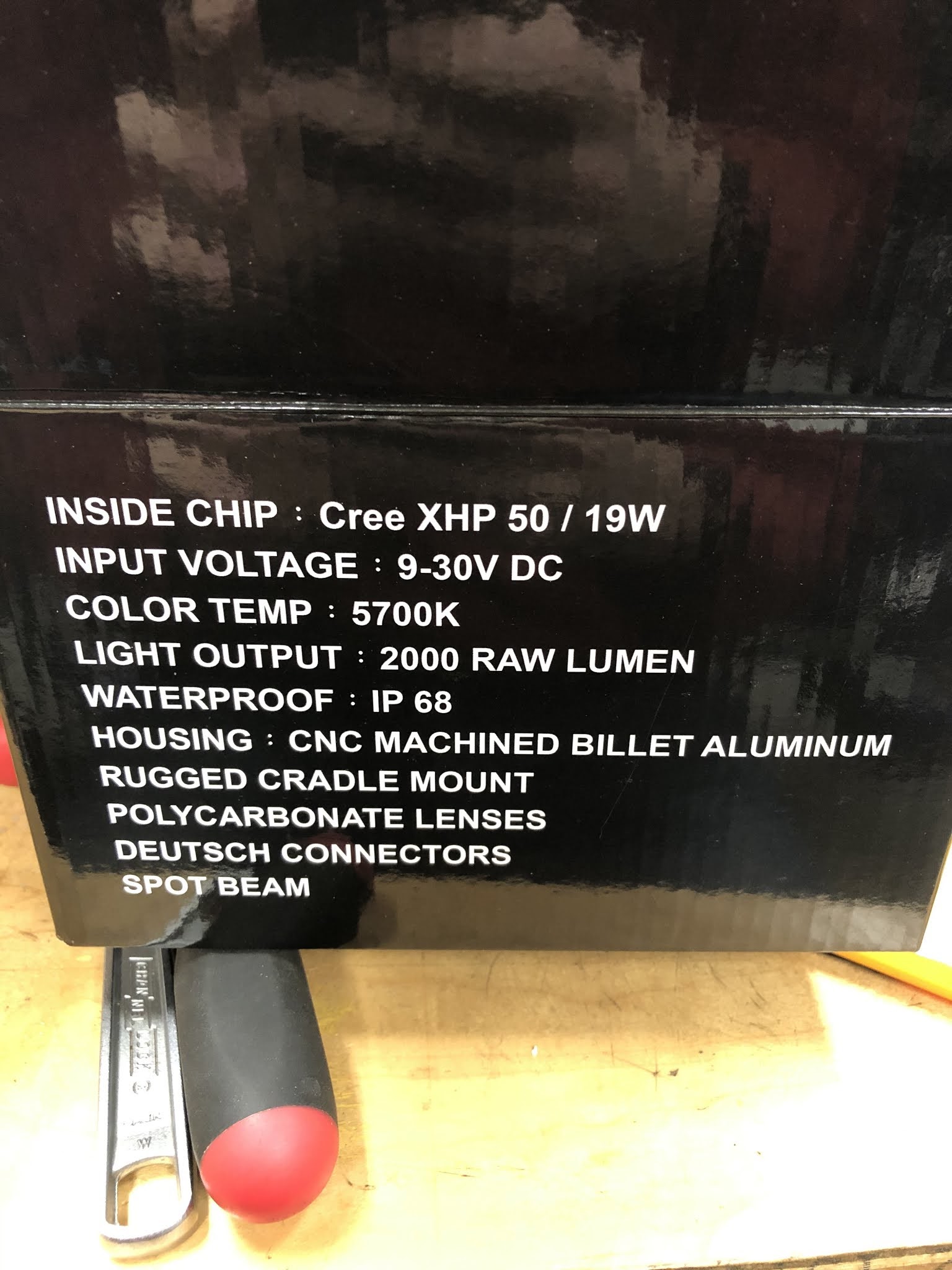
Fully lit, each Cyclops Aurora proves 19W of main LED lighting. That's plenty to through a beam a few hundred metres ahead with a decent spread to the light up the sides of the road. The result is a more complete wash of the way ahead than the OEM headlights alone achieve, especially with their sharp horizontal cutoff. The halos alone are also extremely bright and provide a substantial orange wash on the road ahead.

As for mounting the lights, there are few after-market brackets available. I wanted one that mounted to the lower triple clamp so the lights would turn with the bike (since the headlight doesn't). The best quality option I found was from Rugged Roads, although the OEM in the UK didn't have stock so I had to order from Germany (and it was cheaper than ordering from the manufacturer!). The bracket is top quality, nicely finished, and provides a sturdy and discreet mount for the lights in a relatively protected location. Note that if you've installed the high-fender kit on the Tenere, you will likely need to consider another mounting option since this bracket uses the high fender bolt holes. 


When I ordered the lights I didn't notice there's a special harness option available for the Tenere 700. Turns out you need this harness. I had intended to make my own harness using OEM connectors ordered from Eastern Beaver, and even rigged it all up only to discover that the Tenere uses a non-standard method to turn on the high beams: The ECU effectively grounds the high-beam circuit in the headlight to illuminate the additional LEDs. This is the opposite of typical high-beam lights and how most aftermarket auxiliary lights are controlled. These typically rely on 12V being supplied via the high beam lead when you flick the high beam switch. On the Tenere, you'd need a way to invert the control signal  Sure, there are some solid-state relays available that can trigger when switched from 12V to 0V, but by the time you factor in sourcing the parts and rigging the circuit, you're much better off just ordering the harness from Cyclops. It's only about $75 (don't quote me on that). Cyclops was generous enough to ship me just the harness (which normally isn't sold separately) when I called them to explain my situation.  

The high-beam wire is located on the right side of the dash near the turn signal plug. It's the yellow wire in the 6-position connector. I removed the pin and spliced in a heat-shrink-covered pigtail with a bullet connector to attach to the Cyclops harness. This makes it easy to revert to stock, and I don't like piercing insulation with wiretaps since that can allow moisture ingress leading to corrosion.

The Cyclops harness plugs into the Tenere's left side auxiliary connector (white; near the indicator connector) which is switched with the ignition. 

The Tenere includes four auxiliary connectors at the front: a triangular three-pin connector on each side intended for heated grips and auxiliary lights; and a rectangular two-pin connector on each side for accessories that mount in the dash holes. (Note that the left accessory plug powers the 12V plug on the dash; the other accessory plug is unused on my bike because it requires an obscure connector that I haven't gotten around to switching for something waterproof and more readily available. However, I'm likely to rig it to power the double USB port on my dash which is currently wired into the PC-8.) Since I had already used the righthand three-pin connector to plug in my Eastern Beaver PC-8 expansion box (so it would turn on with the ignition), I routed all the Cyclops wiring to the left side. 

Wiring the lights was initially a bit of a chore, mainly because of the lack of room to tuck away the extra wiring. I won't describe the gong-show of different options I tried to hide the relay and wiring inside the headlight housing. Don't waste your time with this approach. It would be the neatest, but it just doesn't fit because of the Cyclops switch relay, and it also creates the problem of being a pain to access in the event of an electrical gremlin.  

The method Cyclops recommended to position the wiring didn't seem very practical to me so I experimented with some different approaches. In the end, I mounted the slack wiring as a vertical loop against the left fork inside the triple clamp, positioning the connectors in this location with a short section of bicycle inner tube for mechanical protection, and zip-typing the whole mess to the fork tube. The relay and excess wiring got zip-tied to the plastic frame mount near the aux connectors, where it's easily accessible by removing the left body panel and is reasonably well protected from rain and splashes. Overall, the arrangement minimizes flexing of the wires and keeps it clear of the other wire and cable spaghetti in this area when turning the bars. 

After a few thousand kilometres of riding the lights have performed very well. The orange glow really seems to catch people's eyes and it makes a striking front-end for the Tenere. Illumination is greatly improved and the beam spread is easily adjustable to ensure both a good wash of area lighting (looking a bit wall-eyed on my bike) as well as a safe cutoff height to reduce the risk of blinding of oncomers. While a dimmer can be used with these lights (and I use a Skene with my WRR setup), I don't feel it's necessary given the always-on conspicuity of the orange halo by itself. Flicking the high beams gives that extra sauce for max visibility. 

My only complaint with the lights is the factory strain relief on the aluminum housing seems to be an inflexible material, causing the external insulation to pull back from the internal wiring. While I could tuck it back together, this is a weakness in the environmental integrity that I'll need to keep an eye on. Some silicone tape or sealant may be needed to ensure a better mechanical connection in this location.  

Friday, December 25, 2020

Passages - A short ADV movie

Once again, the combined demands of work, family, and the pandemic have kept me away from posting updates, but I can assure you there's some good stuff to come. This past summer was spent riding as much as possible, exercising the Tenere and getting the suspension tuned, filming some rides, and prepping for another edition of the Ride Around Algonquin Park (RAP)--this time in a much more expanded loop up to Timmins, and with my two riding buddies from our 2018 Continental Divide Ride. More to tell about all that later.

Meanwhile, I've also been learning how to use Final Cut Pro to make movies and have just completed my first exercise which revealed a lot more learning is required. Anyway, I'm happy with the results--except for a few glitches which I had fixed but then must've accidentally undone before finalizing. 

So here it is. Enjoy!


Thursday, August 13, 2020

Tenere 700: Tie-down bracket on passenger foot pegs for soft luggage

The set of Enduristan Blizzard XL soft saddlebags I'm fitting to my Tenere require a tie-down point at the passenger foot pegs. Since I'm not using and have removed the passenger foot pegs, I need a place to loop the lower bag straps since I don't want them wrapping directly around the frame (that'll wear through the finish). R&G Racing offers a nice pair aluminum tie-downs like the one below, which bolt into the foot peg holes. Nice design, but also about CAD$130 and overkill for my needs.

I opted to make my own brackets.  

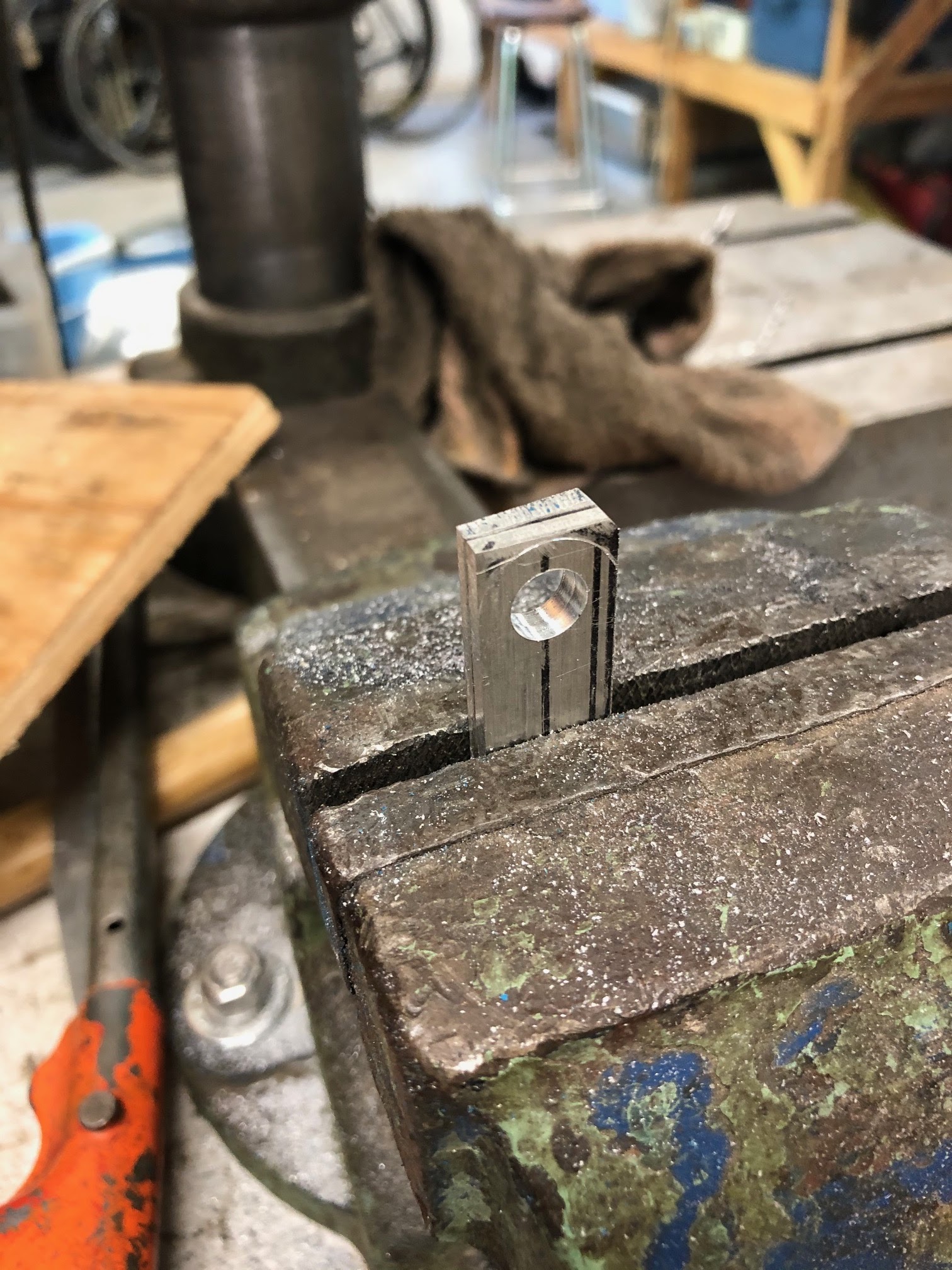
The bolt holes for the foot pegs are on 70mm centres. I figured that one bolt alone (I'm using the original foot peg bolts) should provide plenty of mechanical strength for a 1" nylon baggage strap. But to ensure the strap stays in place, I needed to make a simple bracket from 3mm T6061 scrap aluminum I had lying around. The bracket bridges the two mounting bolts, providing some additional mechanical strength. A few minutes with a hacksaw, file, and drill press had two nice brackets fabricated. I used some aluminum tubing (1/2" dia.) cut to 14mm length as bolt spacers. Total cost about $0 and an hour of effort, since I had the scraps lying around. But if you had to buy the aluminum, tubing, and paint, you're still looking at <$20 with lots of material left over.

The tubing takes the bulk of the load from the webbing loop which pulls up to the rear, in line with the frame tube. Some light sanding, rounding of edges, and coats of Krylon had the end product looking pretty good. 

I though about sliding some plastic tubing over the brackets to provide additional protection for the straps, but this is probably unnecessary. 

Since the Enduristan Blizzard bags are a rackless design, they are meant to press against the rear body panels. While the bags have some nice padding on the inside, I opted to apply some 3M film to the lower section of the paint to protect again inevitable wear from grit. Not the neatest application job, but this was my first time trying a wet application. I'll post the template I used in case you want to cut your own film. 


Next up is fitting the bags. An Adventure Spec top rack is also on its way, which may change my mounting method slightly. Will post on how it all comes together.

Monday, August 3, 2020

Tenere 700: Review at 3800km


Everyone wants to check out my bike and asks me how I like it. I love it. Now that some of the lustre has dulled and it's covered in dirt (as it properly should be) after 3800km of mostly gravel and forest roads, here's my update on how the love affair continues. For reference, I'm coming from a modified WR250R (which I still have) and a 2019 Africa Twin (which I bought new and sold after only two weeks of riding because it just didn't click with me). 

Isn't is top heavy? 
Nope. Even with a full tank, it carries its weight surprisingly well. Cornering and low-speed handling is precise and controlled, even on dirt. There isn't that feeling of "oh sh*t!" when leaning too far; the bike just turns and sticks. Even on dirt at speed, it doesn't have that feeling of running away from you if you hit a corner too hard and risk going into the rhubarb. For comparison, my Africa Twin felt ponderous, like a container ship plowing through heavy seas. The Tenere feels like a speed boat going over the waves. It feels about as top-heavy as my WR250R which is taller and has an aftermarket tank with the volume as the Tenere's. 

Yeah, but my 790 Adventure R / Modified DR650 is way lighter!
So what? There's always going to be some other bike that does something else better or worse, or has better specs on paper. What really matters is how your bike feels for you. Does it let you ride what you want and have fun? The Tenere does that for me: it feels just like my WR250R but with 2.5X more power, which really puts a smile on my face. It has way better traction control because of that smoooooth CP2 engine. My riding skills are absolutely the limiting factor in what the Tenere can do; not the extra weight. Pol Tarrés is proof of that!

How's the suspension?
Now that I've got it mostly sorted out, it's pretty decent. Most reviewers agree that the rear spring is too soft if you're over 65kg (I'm 87kg buck nekkid). I upgraded to an 80N-mm spring from Rally Raid and, with the preload at zero, the rider sag is now -60mm (which will go down to the target -70mm or 30% with my usual gear on, since ridin' nekkid is generally frowned upon). For the forks, I kept the stock springs but installed the Rally Raid preload fork caps with 5mm spacer and three turns of the pre-load adjustment. This gives me -64mm of rider sag (30%). After fiddling with compression and rebound I found a decent compromise between street and dirt. Traction in dirt--even with the stock tires--is surprisingly good even at speed, so I figure the settings are good. However, I'm considering some re-valving this winter to improve high-speed compression/rebound performance. Overall though, the suspension is fine. I'll be loading up the bike with soft luggage soon and then will have a chance to see how it performs under load. 

Isn't the tank too small? Aren't you worried about running out of gas?
Nope. The gas gauge is a little wonky though: It doesn't move for the first 100km, then it drops a bar, then it starts racing towards empty. The Low Fuel light comes on when there's about 1/4 tank (3-4 litres) left! There's a solid 300km range, and probably 350km if you aren't hard on the throttle. I'll carry a 1-gallon RotoPax for longer trips because I don't like to plan more than 300km between fill-ups to allow for the inevitable extra distance from wrong turns, etc. Overall I've been seeing about 3.6-4.6 l/100km fuel economy under spirited riding, and I'm probably averaging about 4.3-4.5l/100km on longer, steady stretches.

How's the wind protection?
I'm just over 6' or 183cm and I wear a peaked helmet (Shoei Hornet). There is almost zero buffeting of the helmet, quite unlike my experience on the Africa Twin. If I duck down about 2", there's a quiet pocket of air and the wind noise is substantially reduced. Anyone shorter than me is going to have a great experience with the wind protection. I don't find the wind noise too bad though; I ride with ear plugs anyways. It's not so loud that I can't enjoy music on my Packtalk Bold headset. Overall I find the protection pretty good and I don't plan to change anything. It's a motorcycle, not a luxury car. 

What would you change?
These are the mods I've made, and all of them have proven worthwhile:
  • Rally Raid fork preload caps
  • Rally Raid shock spring (80 N-mm)
  • Rally Raid stainless steel from hub spacers
  • CamelADV anti-bobble brace for tower
  • Outback Motortek skid plate (essential; the stock guard is pretty flimsy)
  • Outback Motortek lower engine guards
  • B&B Offroad tail tidy
  • Eastern Beaver PC-8 switched power bus
  • Oxford heated grips
  • USB port
  • R&G Racing case covers (protects the water pump and more)
  • Barkbuster Storms
  • Doubletake Mirrors
  • AdventureSpec rear rack (on order; not installed yet)
  • Rally Raid GPS mount
  • Yamaha chain guide (essential)
  • Yamaha radiator guard (essential)
  • Wider pegs (to come)
I didn't mind spending a couple grand on the above farkles because it got me the bike I wanted and all bikes need some customizing anyway. I didn't spring for the adventure seat because I'm waiting to see what Seat Concepts comes up with. The stock seat isn't too bad for me anyway. It's a more compact riding position than on my WR250R, but somehow not as uncomfortable as I initially expected. 

I plan to install a set of Cyclops LED lights because the stock lights, while not bad, don't provide as much coverage as I'd like for our gloomy fall riding.

The stock tires, Pirelli Scorpion STRs, handle very well on gravel and pavement. Kudos to Yamaha for putting on decent rubber. I have a Motoz Tractionator Adventure rear and Shinko 804 front waiting to go on next. 

But don't you miss all the electronics and traction control?
Nope. Had that on the Africa Twin and found it got in the way of just enjoying the ride. I wish the Tenere's ABS off-switch stayed off when the ignition is on but the engine is killed, because that would eliminate a lot of button-pushing during frequent stops. Overall the display works fine. I spend most of my time watching the scenery anyway.

If there's one thing I would change, it's Yamaha's location for the selector switch on the right side. It's almost impossible for me to push it with my right thumb while riding. A thumb switch on the left side would probably work much better. This winter I may see what I can rig in parallel to the OEM switch. 

How is it to service?
Yamaha has put a lot of thought into how this bike is assembled and as a result it's extremely simple to strip down for access to things like the oil filter, air filter, etc. Changing tires is a bit fiddly with the twin front rotor, but entirely doable. By comparison, the Africa Twin was a nightmare in all respects.

The engine is only 72 HP! Every KTM since 1973 is at least twice as powerful!!1!1! 
Yeah, I don't feel like I'm missing out on power except maybe when I'm passing at top highway speed in a headwind going up a steep hill. But that's a tiny percentage of my riding time. Most of the time I'm on rural roads, gravel, dirt, rough terrain. The 72 or however many ponies are more than enough to spin the tire and have a blast. What that number doesn't tell you is how electric-motor-smooth the engine is, and how torquey it is at low RPMs. You can crawl along in 2nd or 3rd, give it some gas, and spin up to speed in no time. The engine is a beautiful work of tractable power. Easy to ride all day long at any speed, standing or sitting. 

Does it need bar risers?
No. At 6' tall, I find the riding position nicely balanced in stock form. I did rotate the bars forward a touch though. 

Conclusions
If you like the WR250R, you'll probably love the Tenere 700. It's just a big WRR, with all the power that the little 250 could never deliver, and at only a small perceptible weight penalty. If you prefer the edgy, full-concentration, high-strung power and handling of a KTM, you'd probably find the Tenere to be a little boring perhaps. If you're riding an 800GS or similar BMW, you'd probably find the Tenere to be just as much bike but slimmer and lighter-feeling in your hands.

This summer I'm doing a longer tour with luggage, and we'll see how the Tenere performs under load. 

Thursday, June 25, 2020

Tenere 700: Outback Motortek engine guards and skidplate

Oh boy, did I ever agonize over what skid plate and crash bars to choose! On the one hand were excellent options based on engineering requirements: these included guards and skid plate from Adventure Spec, the plastic skid plate from AXP Racing, and even the Yamaha OEM guards and skid plate. On the other hand, COVID's interference with supply chains made some options unavailable within a reasonable timeframe. Since I didn't want to get stuck with nothing for when my bike arrived in early June, my options converged to the lower crash bars and skid plate from Outback Motortek. They appeared to be in stock and I'd been satisfied with the versions I'd installed on my Africa Twin. 

Evidently, every other proud new owner of a Tenere in Canada had the same idea. My "in stock" items were actually sold out at the Canadian distributor and so I ended up waiting more than a month for delivery after placing my order. Now that I've finally sorted out the installation, here are my observations and recommendations in case you're considering the same parts. 


First, Outback Motortek is widely recognized as having good stuff. Their materials, design, fit, and engineering all seem pretty solid and the company takes pains to test the practical effectiveness of their products. So, no real concerns about the engineering. I didn't opt for the full (upper) crash bars because of the weight they posed up high, and I figure that the combination of lower engine guards with pannier rack and panniers will provide adequate protection for low-speed tumbles. (R&G engine case covers are also on order to protect the vulnerable water pump.)

The high molecular weight tape inside the frame clamps is a nice touch to protect your bike. However, the clamp was more than snug on the frame, and tightening the bolts proved tricky. 


Some customers have reported poor finishing on some of Outback Motortek's parts lately (e.g. weld spatter and uneven fill) as well as some fitment being a nuisance. Both my left and right guards showed some of these minor problems, but they were easily resolved. 

The hardware included in my kit did have one significant shortcoming. Each guard uses an M12 bolt inserted through a 15mm high collar to mount the midpoint of the guard to the engine case through a frame member. The right-side bolt is 50mm long; the left side about 35mm. Since they thread into a major load point, you need a solid connection. However, the longer of the two M12 bolts provided in my kit was only about 55mm long--too short to provide more than about 6mm of thread inserted into the engine case. There's no way I'd compromise the connection strength at this location with such little thread insertion, where at least 20mm is required as per the OEM bolt. 

The following pic shows the OEM M12 engine bolt for the right side (black; 50mm long) compared with the longer of the two bolts provided in the kit (55mm; silver, in the middle). On the right side is a 65mm bolt which I ordered to ensure sufficient thread insertion. The specification of the 65mm bolt is:

M12-1.25 x 65mm, DIN960 Class10.9 Zinc (note the thread spacing of 1.25mm; 1.50 mm is more common in M12). Fastenal.ca carries this as part #11114018, cost of $2.00. The 65mm bolt has a 19mm hex head vs. 17mm for all the other bolts; I couldn't find a 17mm version. 


Here's the right side OEM bolt compared to the new 65mm bolt in the same position. The photo distorts the length difference; they're actually very close. 


For the left side engine guard, you can re-use the 50mm OEM bolt from the right side since it gives exactly the extra 15mm you need to ensure sufficient threading (and is the same length as the longer of the two kit bolts I received). Here's the 50mm bolt from the kit mounted in the collar and compared with the OEM left side bolt. Don't forget to use a washer when installing either of the 50mm bolts on the left side. 


The inside of the collar had a rough weld that needed a bit of filing so the bolt would sit flush.


The easiest way to install the guards is to first remove the two front body panels on each side of the bike (i.e. the panel with the turn signal attached and the small vented panel next to it). This provides access to properly align, hand-thread, and then torque the engine bolts to 75 N-m. I was not able to fit a socket onto the left side engine bolt because the guard was in the way (a minor design flaw). The two M6 hex bolts for the upper guard attachment point should be torqued to 30 N-m. Note that Yamaha thoughtfully made the OEM bolts long enough to accept the guard and ensure complete threading. Here are the OEM bolts (black) compared with the kit bolts. The OEM bolts on the left side have little rubber sleeves over the extra exposed thread on the inside. 


I found it easiest to install the engine bolt first, then the two M6 hex bolts at the top, then the lower cross-bar bolts, then the lower frame bolts for the U-bracket. 

The finished assembly seems to be sturdy. 


If I was choosing engine guards again, I'd probably opt for the Yamaha guards since they seem to have held up well for Nick Sanders and the two KAP2CAP riders. Plus they give the option to mount small bags, which is appealing. However, for my modest needs, the lower guards should do just fine.

As for the skid plate, it's a no-brainer to install and is a serious upgrade from the flimsy stock guard. I added a patch of 3M sound deadening material to the inside bottom on the left side (away from the exhaust pipe) to help reduce ringing vibrations. This seems to work, based on a highly scientific finger-flick test. 


The Outback Motortek guard uses much thicker material. 


Wednesday, June 24, 2020

Tenere 700 tail tidy: B&B Off-Road Engineering

As with many Japanese bikes, the Tenere 700 comes with an OEM monstrosity of a number plate holder hanging far past the tail light and adorned with chinzy reflectors, where it's readily exposed to breakage on your first tip-over in the woods. As with my WR250R, one of the first mods to my Tenere has been to show that booty some love and install a tail tidy. 

Now that the Tenere 700 has been out for a year, those of us in North America who are now just getting the bike can benefit from a wide range of tail tidy options. CamelADV, Adventure Spec, Rally Raid UK, and R&G all offer some good options. 

But the one I chose comes from B&B Off Road Engineering out of Australia, where there's a solid Tenere 700 following and some of the hardest-core riders of this bike in the world right now. I chose B&B's tail tidy because it offers a solid reinforced mechanical design, it doesn't require cutting the OEM plastics, and it has a good fit and finish and a decent sealed LED plate light. Mine was the first to be delivered to Canada, and having received it only 10 days after placing my order, I installed it right away in one evening. 

For Canadians considering the B&B option, I recommend ordering direct from Australia because factoring in the exchange rate and $30 of duties, it ends up significantly cheaper (and probably faster) than ordering from B&B's US distributor. plus I had excellent service from Sarah at B&B, who was quick to let me know when shipping to Canada was re-opened following the COVID shutdown. Go Commonwealth! 

All the parts come nicely bubble-wrapped. The included hardware is mostly metric stainless steel. I replaced some of the nuts with stainless locknuts (M5). 

What's in the box

The tidy is made from aluminum, doubled in places with welded reinforcements. The whole thing is coated in a thick optional black finish (standard is silver) that looks like it should withstand significant abuse.

Here you can see the reinforcement plate for the turn signal stalk. B&B has an optional insert to allow you to install round, threaded signal mounts, which I plan to adopt when I can order some LED signals. 


This is the top plate that bolts into your subframe. Again, beefy construction. 


The number plate light is a completely sealed LED unit. Looks to be decent quality for both the plastics and wiring.


I like how the metal wiring cover reinforces the structure of the number plate holder. There's no flex in this system, so I don't expect any metal fatigue cracking. 


B&B includes easy to follow instructions to remove the OEM tail assembly. The Tenere 700 is so easy to work on... all the bolts are easily accessible and all you need are 8mm and 10mm sockets and a 4mm and 5mm hex to remove the body panels. Make sure you label your turn signals so you know which side to install them on--the wiring only connects one way! 

Installation is a breeze. To connect the number plate light, I cut off the OEM connector and spliced it into the B&B wiring with some heat-shrink tubing and electrical tape to reseal the harness cover. Connect the white and black wires together (ground) and brown and blue together (+12V). Check your wiring by turning on the key before putting everything back together.

When installing the tail tidy wiring cover, I had a bit of a challenge threading in the 10mm cap screws provided in the kit because of some minor deformation of the aluminum and plastic coating on the aluminum threads. One bolt went in fine, but the metal on the other side of the cover was lifted up a bit and the short fastener wouldn't quite reach. I used a longer bolt to clean out the threads and wind things in with all fasteners installed loosely, then replaced the long bolt with the correct shorter one. It's really not that fussy though, and it all went together fine. Fit overall is excellent and no filing or drilling was required except to mount a reflector bracket (see below) and my number plate (no holes are provided). 


Here's all the crap left over. Easily a couple of pounds of plastic and metal! 


One thing the B&B kit is missing is a way to attach a rear reflector. I made a simple bracket out of some scrap stainless steel and sprayed it black with Krylon paint. Last thing I want is to get hassled (or worse)  during a police stop because I'm missing a required reflector! 


This is the OEM reflector bolted on. I drilled three holes in the B&B number plate holder to attach the bracket using some stainless steel bolts. 


There's nowhere to attach side orange reflectors, but what's neat is that even when you remove the OEM plastics, Yamaha has thoughtfully included knurled handgrips under the outer handgrips for the pillion passenger. The flat area right above the grips is a perfect spot to attach some 3M reflective tape. The tape is flush to the surface and therefore protected, yet provides a wide view of 10 square inches of reflector per side, versus the 3 square inches provided by the OEM round reflectors per side. A good conspicuity upgrade in my mind! 


One last note is that the brake light has a small bit of foam stuck to the bottom where it contacted the OEM plastics. When you've installed the B&B kit, this foam doesn't touch anything. I peeled it off and reattached it further inboard so it wedged between the light and the B&B plate. While it doesn't look like the tail light will move around much on rough terrain, repositioning the foam adds a little bit of extra vibration protection.

Overall I'm very pleased with this kit. It's easy to install (couple of hours), solidly built, and looks great. With the addition of a rear reflector and the side tape, I see no reason why the bike shouldn't meet the same regulatory requirements as the OEM configuration.